


The Push-Pull Dynamic: Why You Keep Chasing People Who Keep Running — And How to Finally Break Free

By Heal and Shine with Komal
There is a very particular kind of exhaustion that nobody really talks about.
It's not the exhaustion of working too hard or sleeping too little. It's the exhaustion of loving someone who is sometimes so completely there — and then suddenly, without warning, completely gone. It's the exhaustion of riding a wave that never lets you reach the shore. Of being held close one moment, and in the very next, feeling like you imagined the whole thing.
One day, they're texting you every hour, calling you beautiful, making you feel like the most important person in the world. The next day — silence. You check your phone every few minutes. You replay the last conversation looking for what you did wrong. You consider texting, decide not to, then text anyway. And the moment they finally respond, that warm rush of relief floods through you — and you tell yourself, "See? It's fine. I was overreacting."
Until the next time it happens.
This is the push-pull dynamic. And if you're reading this, you probably know it in your bones — not just in your mind, but in that deep, cellular, can't-quite-explain-it part of you that both dreads and craves the cycle at the same time.
Here's what I want you to know before we go any further: you are not crazy. You are not weak. You are not "too sensitive" or "too needy." You are a person whose nervous system learned a very particular rhythm a long time ago — and that rhythm, as painful as it is, feels like home.
Let's talk about all of it. The psychology. The science. The soul. The ancestors. The stars. And most importantly — how you actually get out.
What Is the Push-Pull Dynamic?
At its most basic, the push-pull dynamic is a relationship pattern where one or both people alternate between closeness and distance in a way that creates a painful, addictive cycle.
It looks like this:
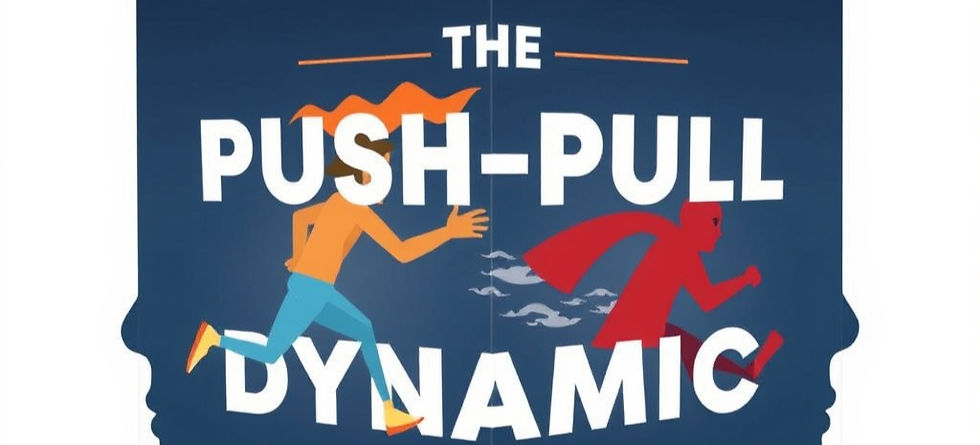
Person A gets close and warm → Person B gets scared and withdraws → Person A panics and chases → Person B either runs further or comes back briefly → the closeness returns → eventually Person B withdraws again → the cycle repeats.
Sometimes the roles flip. Sometimes the same person is both the pursuer and the distancer in different relationships, or even within the same one. Sometimes it's subtle — a slight emotional withdrawal, a cooler text, a sudden unavailability. Sometimes it's dramatic — disappearing for days, hot and cold swings, love-bombing followed by complete coldness.
But underneath all of its forms, the dynamic shares the same invisible architecture:
Love feels conditional. Connection feels dangerous. Closeness triggers fear. Distance triggers longing. And the cycle keeps spinning because both people are unconsciously doing exactly what their nervous systems were trained to do.
Your Nervous System Doesn't Know the Difference Between Safe and Familiar
This is the single most important thing in this entire blog. So I want you to really sit with it.
Your nervous system does not know the difference between what is safe and what is familiar. It only knows what it knows.
When you were a child — tiny, completely dependent, neurologically forming — your nervous system was watching everything. It was recording how love worked in your home. It was taking notes on when closeness was available and when it wasn't. It was learning what you had to do to keep the connection intact. It was memorizing the rhythm.
And if that rhythm was inconsistent — if a parent was sometimes warm and sometimes cold, sometimes present and sometimes checked out, sometimes loving and sometimes punishing — your nervous system registered that inconsistency as the definition of love.
Not because love actually looks like that. But because that was what love looked like for you. And our nervous systems, in their beautiful, loyal, sometimes heartbreaking wisdom, spend the rest of our lives recreating what they know.
So here you are, years or decades later, in a relationship that hurts in a very specific, familiar way. And your nervous system isn't alarmed. It's almost relieved. Because this — the uncertainty, the push and pull, the constant low-level anxiety of wondering where you stand — this feels like love.
And the person who is consistently kind, consistently available, consistently present? Something about them makes you feel slightly uneasy. Too easy, maybe. Or boring. Or like something must be wrong with them. Your nervous system doesn't recognize it. It doesn't fire up in response. And so you mistake peace for absence of passion, and you keep returning to the chaos that feels like home.
This is not a personal failure. This is neurobiology doing exactly what it was shaped to do.
The Two Roles: The Pursuer and the Distancer
In any push-pull dynamic, there are two primary roles. And what makes this pattern so uniquely painful is that these two types are magnetically drawn to each other — like they were built to find one another.
The Pursuer — Anxiously Attached
The pursuer is the one who chases. When there is distance in the relationship, something deep inside them sounds an alarm — primal, urgent, impossible to ignore. It sounds like: "I'm being abandoned. I need to fix this right now."
So they pursue. They text more. They try harder. They become more accommodating, more available, more willing to shrink themselves just to keep the other person close. They analyze every message. They rehearse conversations. They lie awake at night trying to figure out what changed.
Here is the painful paradox of the pursuer: the anxiety you feel when they pull away — that heart-racing, breath-shortening, desperate urgency — that doesn't feel like fear to you. It feels like love. It feels like proof of how deeply you care.
But it isn't love. It's an activated attachment system doing everything it can to prevent what it perceives as abandonment. The intensity isn't passion — it's panic wearing passion's face.
Pursuers often grew up in homes where love had to be earned. Where attention was inconsistent. Where they had to perform, achieve, or manage a parent's emotional state to stay connected. They learned: "If I just try hard enough, if I just love them enough, they'll stay."
That child is still inside you. Still trying. Still believing that if you just do more, be more, love more — they won't leave.
The Distancer — Avoidantly Attached
The distancer is the one who runs. And here's what most people don't understand about them: they are not cold. They are not unfeeling. They are not maliciously cruel, even when their behavior hurts you deeply.
They are terrified.
Closeness, for the distancer, feels like danger. When someone gets emotionally near — when the relationship starts to feel real, when vulnerability is required — something inside them sounds its own alarm: "I'm going to lose myself. I'm going to be consumed. This is not safe."
So they create space. They go quiet. They pull back. They might pick a fight over something small, or suddenly become very busy, or just become emotionally colder without quite being able to explain why. And the more the pursuer chases, the more they need to run — because the intensity of being pursued only amplifies their need for self-protection.
But here's what's crucial: the distancer is not indifferent. The moment the pursuer actually starts to pull away — starts to truly move on — the distancer often comes flooding back. Because distance also frightens them. They just fear engulfment more than they fear abandonment. Until the pursuer starts to leave. And then they remember that losing the connection is also unbearable.
Distancers often grew up in homes where emotional expression was unwelcome or overwhelming. Where love came with control, or smothering, or emotional unpredictability. Where being truly seen felt dangerous. They learned: "The safest thing is not to need anyone. Self-sufficiency is survival."
Why They Find Each Other
The pursuer's intensity confirms the distancer's belief that closeness is suffocating and overwhelming. The distancer's withdrawal confirms the pursuer's belief that love is unreliable and has to be chased. They each recreate the other's deepest wound — and they call this magnetic, agonizing, consuming pull connection.
It is connection. But it is connection built on fear, not on love.
The Psychological Truth: Attachment, Addiction, and the Brain
Attachment theory — developed by John Bowlby and expanded by researchers like Mary Ainsworth and Sue Johnson — gives us a precise map for understanding why push-pull patterns form and why they are so devastatingly hard to break.
When our attachment needs are met consistently in childhood, we develop secure attachment — a basic trust that love is reliable, that we are worthy of it, and that we don't have to fight to keep it. From this foundation, relationships in adulthood feel warm, safe, and relatively uncomplicated.
When attachment needs are met inconsistently — sometimes yes, sometimes no, unpredictably — we develop anxious attachment. When they are consistently unmet or our expression of needs was unwelcome, we develop avoidant attachment. And when our caregiver was both a source of comfort and a source of fear — as in homes with abuse, addiction, or severe emotional instability — we can develop disorganized attachment, which is perhaps the most complex and painful of all.
These are not permanent labels. They are learned patterns. And learned patterns can be unlearned — but not without understanding what you're actually working with.
From a neurological perspective, the push-pull cycle is genuinely addictive. Here's why:
When they pull away, your stress response activates — cortisol, adrenaline, hypervigilance. Your brain goes into a low-grade state of threat. You're scanning for danger, replaying the past, rehearsing the future.
When they come back, your brain floods with dopamine — the same neurotransmitter involved in every addiction from gambling to cocaine. The relief and joy of their return creates a neurochemical high that is more intense precisely because it followed deprivation. This is called a variable reward schedule — the same psychological mechanism that makes slot machines so addictive. Unpredictable rewards produce stronger neurological responses than consistent ones.
This is why you can know, consciously and intellectually, that the relationship is hurting you — and still feel completely unable to leave. You are not weak. You are neurologically bonded to the cycle. The chemistry of it is real.
Understanding this does not make it your partner's fault. It does not make it yours either. It makes it something that needs to be healed at the level where it lives — in the body, in the nervous system, in the deep unconscious patterns underneath.
The Spiritual Dimension: Mirrors, Soul Contracts, and Sacred Lessons
Now let's go somewhere that psychology alone cannot take us.
Spiritually, the people who trigger us the most profoundly are rarely our accidents. They are, in many traditions, understood as our greatest teachers — and sometimes as our most important mirrors.
The person who keeps pulling away, who won't fully commit, who sits in that agonizing in-between space — they are reflecting something back to you. Not about their worth, but about yours. They are showing you, with painful precision, the part of you that still believes deep down that you must earn love. That you are too much. That you are not quite enough. That you have to chase, or perform, or make yourself smaller to deserve the connection you desire.
They are not there to give you what you need. They are there to show you what you haven't yet given yourself.
Many spiritual traditions speak of soul contracts — agreements made between souls before incarnation, to help one another grow in specific ways. In this framework, the push-pull person didn't come to stay forever. They came to break something open in you. To shatter the part of you that was still settling for breadcrumbs and calling it a banquet.
When you begin to see them this way — not as someone who is failing you, but as a soul who is completing a very specific function — something shifts. The anger softens into something more like grief. And grief, unlike anger, moves. Grief moves through and releases.
There is also the matter of karma — not in the punitive sense, but in the sense of unfinished spiritual business. When a relationship has an almost fated quality, when you feel you've known this person before, when the pull is inexplicable even to yourself — it may be that you are completing a cycle that began in another time, another form, another life. The push-pull may be the final exam of a lesson your soul has been enrolled in for longer than this lifetime.
The question the universe is asking through this pattern is always the same: Can you learn to love yourself the way you are longing to be loved by them?
That is the only correct answer.
The Ancestral and DNA Layer: Wounds That Travel Through Time
Here is where science and spirituality meet in one of the most profound ways I know.
We used to believe that our genetics were fixed — that DNA was a blueprint written in stone, unchangeable by experience. We now know this is not entirely true. Epigenetics — a growing and extraordinary field of biological science — has demonstrated that life experiences can affect how genes are expressed, and that these changes can be passed down through generations.
In landmark studies, researchers have found that the children and even grandchildren of people who experienced severe trauma — war, famine, abuse, profound grief — show measurable differences in their stress response systems. They have not experienced the trauma themselves. But their bodies carry its imprint.
What does this mean for you?
It means that the way you respond to love — the anxiety, the hypervigilance, the compulsive chasing, the inability to receive consistent affection without feeling suspicious — may not have originated entirely in your own life. You may be carrying the emotional residue of your grandmother's abandonment, your grandfather's inability to express love, your mother's cycles of painful relationships, your father's emotional walls.
The push-pull pattern may be a family heirloom you never asked to receive.
This is not to remove your personal responsibility for your healing. It is to extend to you a profound compassion: you came into this world already carrying some of these patterns in your cells. The work you are doing to heal them — the awareness, the therapy, the spiritual practice, the conscious effort to choose differently — is not just for you. It is for your entire lineage, backward and forward.
Practices for ancestral healing:
Family constellation work — a therapeutic modality developed by Bert Hellinger that brings the hidden dynamics of family systems to light. In constellation sessions, representatives stand in for family members, and the system's unconscious patterns become visible and workable. Many people experience profound releases through this work that years of individual therapy had not reached.
Journaling the lineage — write out what you know of how love worked in your family. Not to blame anyone, but to see the pattern clearly. How did your parents relate? Their parents? What were the unspoken rules about emotional expression, need, vulnerability? What you can name, you can begin to release.
Ancestral letter writing — write a letter, not to be sent, but as a ritual. Address your lineage directly. Name the pattern. State your intention to release it. Express gratitude for what they survived while also releasing what no longer serves. This is a powerful act of conscious intention — which changes not only your emotional relationship to the pattern but creates new neurological grooves in the brain.
Somatic work — because inherited trauma lives in the body, it often must be released through the body. Breathwork, somatic experiencing, trauma-informed yoga, and body-based therapies can access and release what talking alone sometimes cannot reach.
The Astrological Layer: What the Stars Reveal
For those who work with astrology — whether as a primary lens or simply as one tool among many — the push-pull dynamic leaves very specific signatures in the birth chart and in the synastry (the comparison between two people's charts).
Chiron, the Wounded Healer: When Chiron sits in the 7th house (the house of partnership) or forms challenging aspects to Venus or Mars, there is often a deep, recurring wound in the area of love and relationship. This wound doesn't go away by finding the right person. It goes away when the person does their own healing work. Chiron's gift is that once healed, the wound becomes the source of the greatest wisdom and capacity to help others.
Venus-Pluto aspects: This combination creates relationships of intense, almost magnetic pull — but also power struggles, obsessive dynamics, and the sense that love must be earned through intensity or suffering. People with Venus-Pluto often unconsciously equate love with transformation — which means they may keep choosing relationships that put them through fire. The healing is learning that you can transform through joy, not only through pain.
Moon-Saturn aspects: Saturn near or in difficult aspect to the Moon often indicates an early environment where emotional needs were not fully met — a cold or withholding parent, emotional restriction, love that felt conditional on behavior or achievement. This creates adults who either suppress their emotional needs (avoidant) or feel their emotional needs are excessive and shameful (contributing to anxious patterns).
South Node connections in synastry: When your South Node closely connects with another person's personal planets — their Sun, Moon, Venus, or Mars — the attraction will feel almost karmic. Like you've known them before. And you may have, in the framework of this tradition. But South Node connections keep you tethered to the past, to old patterns, to what was rather than what could be. Your North Node is where your growth lies. And sometimes the most spiritually courageous thing you can do is to release a South Node connection, no matter how familiar it feels.
Lilith placements: Black Moon Lilith in challenging positions, especially in the 7th or 8th house or aspecting Venus, can indicate a soul pattern of attracting — or being attracted to — relationships that are taboo, unavailable, or that stir up deep issues of power, worthiness, and desire.
Astrology doesn't predetermine your fate. The chart shows tendencies, not destiny. But it can offer profound self-understanding — and sometimes seeing your pattern written in the stars helps you take it less personally, and approach your healing with more compassion.
How to Actually Break Free: Deep, Practical Steps
Enough understanding. Let's talk about doing.
Breaking the push-pull pattern is not a weekend project. I want to be honest with you about that, because you deserve honesty, not false promises. This is deep work. It is beautiful work. And it will likely be some of the most important work of your life. But it is work — layered, nonlinear, and worth every moment of discomfort.
Here is what it actually looks like:
Step One: Stop and Name It — Without Shame
You cannot heal what you refuse to see. So the first step is the uncomfortable one: stop defending the pattern and start naming it clearly.
Say it out loud if you have to: "I am in a push-pull dynamic. I am addicted to the cycle. What I am calling love is partly fear — fear of abandonment, fear of my own unworthiness, fear of what I might have to feel if I stop running toward someone who is running away."
This is not self-attack. Self-awareness and self-attack are very different things. Awareness says: "I see this clearly." Attack says: "I am bad for this." We want the first. We do not need the second.
Step Two: Nervous System Regulation — Every Single Day
Because this pattern lives in the nervous system, the healing must be nervous system work — not just cognitive insight. Understanding the pattern intellectually changes very little if your body is still running the old program.
Daily nervous system regulation is not optional. It is the medicine. Here is what actually works:
Extended exhale breathing: Breathe in for 4 counts, out for 6-8 counts. The extended exhale directly activates the vagus nerve and shifts you from sympathetic (fight-or-flight) to parasympathetic (rest and safety). Do this for five minutes when you feel the urge to chase, to text, to spiral.
Physiological sigh: A double inhale through the nose followed by a long exhale through the mouth. This is the fastest known method to reduce acute stress. Researched extensively at Stanford. Two or three of these and your nervous system begins to settle.
Somatic shaking: Stand up and shake your body — legs, arms, torso — for two to three minutes. This is not ridiculous; it is neurologically sound. Animals shake after a threat response to discharge the stress hormones from their system. Humans stopped doing this, and we store that activation as chronic tension, anxiety, and emotional reactivity.
Cold water: Splashing cold water on your face or holding your wrists under cold running water activates the dive reflex and slows your heart rate almost immediately. Useful during moments of high emotional activation when you feel like you might do something you'll regret.
Nature and grounding: Bare feet on grass or soil. Walking slowly. Trees. Water. These are not metaphors. Contact with the natural world literally regulates the nervous system at a measurable level. Make this a daily practice, not an occasional luxury.
Step Three: Feel the Feelings You've Been Chasing Away
Here's a truth that is almost paradoxical: you chase them because you are running from yourself.
The moment they pull away, you feel something unbearable rise up inside you — a terror, a grief, a hollow loneliness that feels as though it will consume you if you stay with it even for a moment. So you reach for your phone. You create contact. You chase. Because as long as you are chasing them, you don't have to feel that.
But that feeling — that ancient, terrifying emptiness — is not about them. It was there long before them. They just revealed it.
The healing is to stay. To sit with the feeling without running toward them or away from it. To breathe into it and let it be there. To say to it: "I see you. You are old. You are not the truth of me. And I am not going to chase my way out of you today."
Feelings that are truly felt, move. Feelings that are avoided, calcify into patterns.
Step Four: Therapy — Choose the Right Kind
Push-pull patterns are typically rooted in early attachment wounds and sometimes in trauma. This means that the right kind of therapeutic support can change everything — not slowly, but quite genuinely and sometimes profoundly.
What works best:
EMDR (Eye Movement Desensitization and Reprocessing): Developed specifically for trauma, EMDR uses bilateral stimulation to help the brain reprocess painful memories and the beliefs they created. Extraordinarily effective for people whose patterns are rooted in early relational trauma. Many people experience in a handful of sessions what years of traditional talk therapy did not shift.
IFS — Internal Family Systems: This approach works with the understanding that we have different "parts" of ourselves — the part that chases, the part that runs, the part that believes it's unlovable, the part that is exhausted and just wants to be held. IFS helps you build a relationship with these parts rather than being unconsciously run by them. The results, for people in attachment-based patterns, are often quietly revolutionary.
Somatic Experiencing: Developed by Peter Levine, this body-based therapy works directly with how trauma is stored in the nervous system. For patterns that feel physically compulsive — the urge to text, the physical anxiety of distance — somatic work can reach places that talking simply cannot.
Emotionally Focused Therapy (EFT): If you are working on this within an existing relationship, EFT (developed by Sue Johnson, based directly on attachment theory) is one of the most evidence-based approaches for healing push-pull patterns between partners. It helps both people understand their attachment dances and create new ones.
Schema Therapy: Addresses the deep core beliefs formed in childhood — "I am not lovable," "People always leave," "I have to earn love" — and works to update them. Effective for long-standing patterns that feel deeply fixed.
You are not too broken for therapy to help. But you may need to try more than one approach, or more than one therapist, before you find the right fit. Please do not give up if the first one doesn't feel right. The right therapeutic relationship is itself a healing experience.
Step Five: Grieve What You Never Had
Underneath every push-pull pattern is a grief that has not been fully felt.
The grief for the consistent, unconditional, safe love you needed as a child and did not receive in the way you deserved. The grief for all the years you spent chasing people who couldn't give you what you needed, and all the pain you accumulated in that chasing. The grief for the version of yourself who tried so hard, loved so deeply, and still ended up alone in the cycle.
This grief deserves to be felt. Not performed, not analyzed, not immediately resolved — just felt.
Cry for that child who kept trying to earn love from someone who didn't know how to give it freely. Cry for all the nights you lay awake wondering what was wrong with you. Cry for the love you gave that never came back the way you needed it to.
Grief, when truly allowed, is one of the most powerful releasing forces we have. It clears what has been stored. It makes room for something new. And it is the most honest response to genuine loss.
Step Six: Reparent Yourself With Fierce Consistency
You are learning, perhaps for the first time, what consistent love actually feels like. And you may have to teach yourself — because no one else taught you.
Reparenting means becoming the parent you needed. It means showing up for yourself with the same urgency you showed up for people who kept disappearing. It means keeping promises to yourself. Speaking to yourself with warmth. Holding your own pain with compassion instead of criticism.
Concrete practices:
When the urge to chase rises, pause and ask: "What do I actually need right now?" Then give that to yourself instead of seeking it from them.
Write yourself letters. Seriously — write to yourself from the wise, loving perspective of the parent you deserved.
Create daily routines that demonstrate to your nervous system: "I am consistent. I show up for myself. I am safe." Structure and self-consistency are among the most powerful regulators of an anxious nervous system.
Stop abandoning your own needs to accommodate someone who is emotionally unavailable. Every time you do, you confirm to yourself that your needs don't matter. They do.
Step Seven: Learn to Recognize — and Choose — Safety
When a consistently loving person comes into your life and your nervous system goes flat — notice that. Don't leave. Investigate.
Ask yourself: "Is this person actually boring? Or is my nervous system unfamiliar with this frequency?"
Sit with it. Get to know them without the overlay of your pattern. Let the relationship develop at a pace that allows genuine connection rather than anxious chemistry. Notice what it feels like to be with someone who doesn't make you earn their presence. Notice if something begins to shift — if the quiet begins to feel not like absence of passion, but like the presence of safety.
Safety is not dull. Safety, when you have never truly had it, is the most revolutionary thing you will ever feel.
The Spiritual Tools That Actually Help Break This Pattern
This is the section I hold most close to my heart — because psychology can explain the pattern, but spiritual tools are what move the energy. What shift the frequency. What speak to the parts of you that exist beyond your mind and your memories.
If you are a spiritual person, these tools are not supplements to your healing. They are central to it. The push-pull pattern is not just a psychological wound — it is an energetic one. And energy responds to energy.
Here is a deep, honest, practical guide to the spiritual tools that can help you break free.
1. Meditation — But Not the Kind That Bypasses
Let me be clear first: spiritual bypassing is real, and it is one of the biggest traps on the healing path. You cannot meditate your way out of grief you haven't felt. You cannot chant your way over wounds that need to be looked at. Meditation is not an escape from the work — it is a doorway into it.
The meditation that helps here is not the kind where you float above your feelings and observe them from a distance, untouched. It is the kind where you sit with what is actually there.
The Pause Meditation — For When the Urge to Chase Hits: The moment you feel the impulse to text, to check their profile, to create contact — stop. Sit down. Close your eyes. Place one hand on your heart and one on your belly. Breathe. And ask yourself: "What am I actually feeling right now, underneath the urge to reach out?"
Stay there. What you will often find is not love. It is fear. It is the old childhood terror of abandonment. It is a child inside you screaming: "Come back. Please come back."
Don't reach for your phone. Be with the child. Breathe for them. Say to them: "I'm here. You don't have to chase anymore. I've got you."
This is where the healing actually lives.
The Heart Coherence Meditation: Place your hand on your heart. Breathe slowly — in for 5, out for 5 — directly into your heart space. Visualize your heart softening, opening, becoming warm. Call to mind something or someone that brings you genuine peace — a pet, a memory, a place in nature. Let that feeling of warmth expand with each breath. Do this for five to ten minutes daily.
Research from the HeartMath Institute has shown that heart coherence practice genuinely rewires the nervous system's baseline — reducing anxiety and increasing emotional resilience over time. This is science meeting spirit.
2. Journaling as a Sacred Practice
Journaling is one of the most underrated spiritual tools we have. But not the kind where you recount what happened and stay inside the story. Spiritual journaling is an act of excavation — you are going beneath the story to find the belief that is running it.
Prompts specifically for the push-pull pattern:
"What is the oldest version of this feeling? When did I first feel this exact thing?"
"What do I believe, in my deepest self, that I must do to deserve love?"
"If I stopped chasing entirely — what am I afraid would happen?"
"What would I have to feel if I accepted that they cannot give me what I need?"
"What is this relationship showing me about myself that I haven't wanted to see?"
Write without editing. Write until you hit something true — you will feel it. There is a particular sentence that sometimes emerges in journaling sessions that makes you stop and read it again. That sentence is the medicine.
The Unsent Letter: Write to the person who first taught you that love was push-pull — whether that was a parent, a first love, or a caregiver. Say everything you never said. Be angry. Be heartbroken. Be honest. Don't send it. Burn it, tear it, or simply delete it. The point is not communication — it is release.
3. Affirmations — Used the Right Way
Most people use affirmations incorrectly — they repeat words their nervous system doesn't believe yet, and then feel worse when nothing changes.
The power of an affirmation is not in repeating a truth you don't feel. It is in bridging — starting where you are and gently moving toward where you want to be.
Instead of: "I am worthy of love" (which your nervous system may immediately reject as false)
Try: "I am beginning to understand that I deserve consistency." Or: "Each day, I am learning that love doesn't have to hurt." Or: "Something in me is healing that I couldn't have healed before now."
These land differently because they are true. And from that truth, you can build.
Affirmations work best when spoken aloud, looking into your own eyes in a mirror. This is not as strange as it sounds. The mirror practice is deeply confronting — and deeply healing. Because many of us find it almost unbearably difficult to look into our own eyes and say loving things. That difficulty is information. That difficulty is exactly where the work is.
4. Crystal Healing — Working With Energy
Crystals work on a vibrational level — they interact with the body's energy field and support specific kinds of healing. Whether you approach this scientifically (piezoelectricity, electromagnetic resonance) or simply intuitively, many people find crystal work profoundly supportive alongside other healing modalities.
For the push-pull dynamic specifically:
Rose Quartz — the stone of unconditional love. It works to heal the heart chakra — the energy center most affected by push-pull relational patterns. Hold it during meditation. Sleep with it near your pillow. It gently opens the capacity to both give and receive love without conditions.
Black Tourmaline — for energetic boundaries and protection. When you are caught in a push-pull dynamic, your energetic boundaries are often severely compromised. Black tourmaline helps establish and maintain those boundaries — it grounds you and prevents you from being so easily pulled by another person's energy.
Rhodonite — specifically known for healing old emotional wounds and patterns, particularly around love and relationships. It helps bring buried feelings to the surface — gently — so they can be acknowledged and released.
Lepidolite — for anxiety and emotional stabilization. Contains natural lithium. Extraordinarily calming during the painful period of breaking the chase pattern, when your nervous system is screaming at you to reach out.
Moonstone — for emotional cycles and feminine healing. Particularly powerful for women working with relationship patterns that have a cyclical, almost lunar quality — the rising and falling of the push-pull tide.
Place your chosen crystal on your heart chakra during meditation. Carry it in your pocket or bra throughout the day. Set an intention with it — speak to it, tell it what you are releasing, what you are calling in.
5. Chakra Healing — Where the Wound Lives Energetically
The push-pull dynamic creates damage across multiple energy centers, but the primary ones are:
The Root Chakra (Muladhara) — located at the base of the spine. This is the energy center of safety, stability, and belonging. When we learned in childhood that love was unstable and unpredictable, our root chakra becomes dysregulated. We literally cannot feel safe in our own body, in our own life. We are always scanning for threat, always braced for abandonment.
Healing the root: Earthing (bare feet on soil), red foods, physical movement, drumming, grounding meditations. Affirmation: "I am safe. I belong. I am held by the earth."
The Sacral Chakra (Svadhisthana) — located below the navel. This is the center of emotion, pleasure, intimacy, and creative flow. Push-pull dynamics create enormous sacral disruption — the constant flooding of stress chemicals through this center leaves it either completely shut down or wildly overactive.
Healing the sacral: Dance, hip-opening yoga, creative expression, orange crystals (carnelian, orange calcite), water immersion, honoring your emotions without shame.
The Heart Chakra (Anahata) — the center of love, both giving and receiving. This is where the deepest wound of the push-pull pattern lives. A heart that has been repeatedly reached toward and rejected, or that has learned to love in extremes, closes. It armors itself. And an armored heart cannot receive consistent love, even when it arrives.
Healing the heart: Rose quartz, green foods and nature, heart coherence meditation, practicing receiving (even small acts of kindness — let them land), forgiveness work — not for their sake, but for the freedom of your own heart.
The Solar Plexus Chakra (Manipura) — the center of personal power, self-worth, and identity. The push-pull pattern devastates this center. When your worth has become entangled with whether someone chooses to come back to you, your sense of self becomes fragile, conditional, borrowed.
Healing the solar plexus: Yellow crystals (citrine, tiger's eye), fire practices (candle gazing, sun salutations), assertiveness work, completing tasks you set for yourself, making decisions and keeping them — rebuilding the relationship with your own will.
6. Energy Healing — Reiki, Pranic Healing, and Cord Cutting
Reiki and pranic healing work directly with the body's energy field to clear blockages, release stored emotional energy, and restore flow. A skilled energy healer can work directly with the heart chakra and the emotional body to release what has been held in the field for years — sometimes providing relief that is almost inexplicable through any other lens.
If you've never experienced an energy healing session, I encourage you to try one with an open and genuinely curious heart.
Cord Cutting — this is one of the most powerful spiritual practices for releasing energetic ties to people who are keeping you stuck.
When we are in intense relationships — especially painful ones — energetic cords form between our energy body and theirs. These cords are not metaphors. Many energy sensitives can feel them as real physical sensations. And they keep you entangled even when the relationship is "over" in the physical sense. You still feel them. You still reach for them. You still feel their pull.
A simple cord cutting practice:
Sit quietly. Close your eyes and breathe deeply. Visualize the person in front of you. Feel the cords between you — especially those connecting your heart to theirs, or your solar plexus to theirs. See them clearly.
Now call in your highest self, your guides, or simply the energy of love and truth. Visualize a sword or a beam of light — and with a clear, loving intention, cut the cords. Not with anger. Not with hatred. With love and clarity. Say: "I release you. I release myself. What was meant to teach me has taught me. What was meant to hold me has held me long enough. I am free. You are free."
Visualize the cords dissolving. Fill the space they occupied — in your heart, your belly, your body — with golden light.
This practice can be done as often as needed. You may feel lighter immediately. You may feel a rush of grief. Both are signs it is working.
7. The Moon and Her Cycles — Ritual Timing
The moon has been used for healing and release work across cultures and thousands of years — not as superstition, but as a genuine tool for working with natural cycles of energy.
The Full Moon is the time of release. What do you want to let go of? Write it down — the pattern, the specific person, the belief that you must chase love. Read it aloud under the moonlight or near a window where moonlight falls. Burn it, if it is safe to do so. Say: "I release this. I am ready for what comes next."
The New Moon is the time of intention. What are you calling in? Write it in the present tense — not "I want" but "I am." "I am someone who receives consistent love. I am someone who chooses peace over chaos. I am someone who trusts that I am enough." Read it aloud. Place it somewhere you will see it for the next month.
This is not magic in the sense of bypassing your own work. It is alignment — using the natural rhythms of the universe to support and amplify the inner work you are already doing.
8. Prayer and Surrender — The Deepest Spiritual Tool
And finally — perhaps the simplest, and the most profound.
Prayer is not about religion. It is about surrender. It is the act of placing something — the pattern, the pain, the person — into the hands of something larger than yourself. Whether you call that God, the Universe, Source, Spirit, your Higher Self, or simply Love — the act of surrender is the same.
Because here's what we often don't want to admit: we cannot control whether someone loves us. We cannot control whether they stay. We cannot, through the force of our chasing and our trying and our loving, make someone capable of what they are not yet capable of.
We can only do our work. And then surrender the rest.
"I have done everything I know how to do. I release the outcome. I trust that what is meant for me will not pass me by. I trust that my healing is already happening, in ways I cannot always see."
Say this when you are most desperate to chase. Say this when you have cried everything you have. Say this when you are tired of being strong and tired of working and tired of the whole beautiful, painful journey.
Surrender is not giving up. Surrender is the moment you finally stop fighting the river and let it carry you.
And it always, always carries you somewhere better than where you were trying to force your way to.
A Word on Doing This Within a Relationship
If you are currently in a push-pull dynamic with someone and want to work through it together — rather than leaving — it is possible. But it requires both people to be willing.
Both people need to acknowledge the pattern. Both need to take responsibility for their role in it — not with blame, but with honesty. Both need to be willing to feel uncomfortable: the pursuer needs to practice not chasing, which will feel like dying. The distancer needs to practice leaning in, which will feel like suffocating. Both need support — ideally therapeutic support, ideally together.
The greatest gift you can give a push-pull relationship is to change your own part of the dance. When the pursuer stops pursuing, the entire system has to recalibrate. Sometimes the distancer, when they realize the chase is over, is finally able to step forward. Sometimes they can't — and that tells you what you need to know.
What Love Actually Feels Like When It's Healthy
Because many of us genuinely don't know, let me tell you.
Healthy love feels calm. Not flatline — there is still excitement, still desire, still depth. But underneath all of it is a steadiness. A groundedness. A sense that you do not have to perform or chase or shrink or manage another person's emotions in order to stay connected.
Healthy love doesn't feel like holding your breath. It doesn't feel like you're always auditioning. It doesn't require you to interpret silence as rejection, or warmth as something too good to last. It feels like you can disagree and still be loved. Like you can be imperfect and not be abandoned. Like you can take up space.
It will probably feel strange at first. Your nervous system will question it. It might scan for the problem, because things that feel this safe haven't been safe before. That's normal. That's the old pattern running its final checks.
Give it time. Let safety become familiar. Let your nervous system write a new story about what love can feel like.
And then — slowly, truly, deeply — you will feel yourself stop chasing. Not because you gave up. Not because love stopped mattering. But because you finally, finally understand in every cell of your body:
You were never meant to chase. You were always meant to be met.
Before You Close This Page
If something in here cracked something open in you — good. That crack is where the light comes in.
If you felt seen in these words, please know: you are not alone in this. The push-pull pattern is one of the most common human experiences, and one of the least honestly spoken about. Because it requires us to look at ourselves — not just at who hurt us, but at the part we play in our own pain. That takes courage.
You are not broken. You are patterned. And patterns, unlike character, can change.
You are allowed to want consistent love. You are allowed to stop accepting scraps. You are allowed to stop explaining away behavior that hurts you, to stop making excuses for emotional unavailability, to stop bending yourself into shapes that don't fit just to keep someone who keeps leaving.
You are allowed to be someone who is easy to love — not because you tried harder, but because you finally chose to love yourself that way.
The journey out of this pattern is not linear. You will have setbacks. You will miss the intensity. You will sometimes mistake chaos for passion again. That's okay. Just keep returning to what you now know. Keep returning to the work. Keep returning to yourself.
Because healing is not a destination you arrive at one day. It is the practice of choosing yourself, again and again and again — until it becomes the only thing that makes sense.
With so much love, truth, and belief in you,
✨ Heal and Shine with Komal ✨
If this reached something inside you, please share it. Someone you love is probably stuck in this cycle right now, and they need to know they're not alone — and that there is a way through.
Your healing is not just for you. It ripples outward into everyone you love, every relationship you'll have, and every generation that comes after you.
Shine on.



Comments