


Healing Within Toxic Walls Finding Peace in Unchangeable Environments

Heal & Shine with Komal
Healing • Growth • Truth
Deep Healing • Long Read
Emotional Healing • Psychology • Spiritual Growth
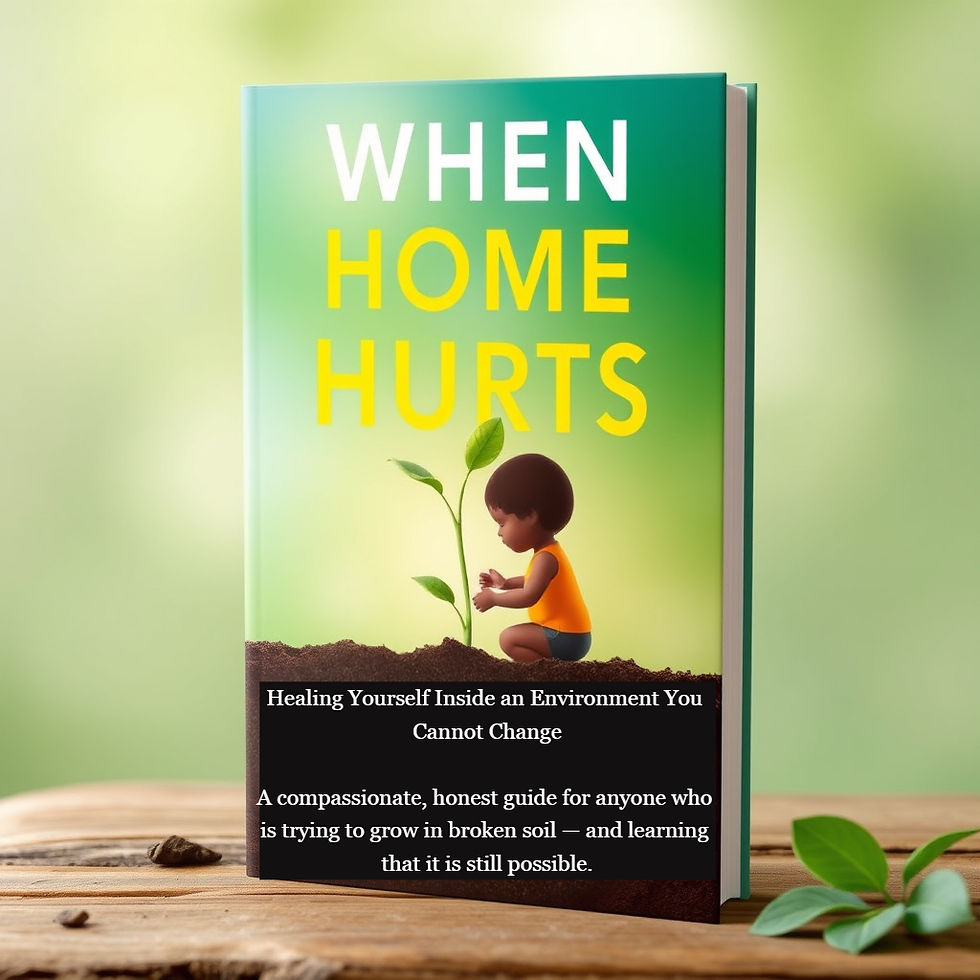
When Home Hurts: While the Environment Around You Has Not Changed
A compassionate, honest guide for anyone who is trying to grow in broken soil — and learning that it is still possible, one day at a time.
By Komal Aravind • Heal & Shine with Komal
There is a kind of pain nobody fully prepares you for. It is not the pain of one bad moment that eventually passes. It is the pain of living inside an environment that hurts — day after day — with no clear way out and no simple solution.
The people around you are not changing. The patterns in that space have been running for years, maybe generations. And yet, somehow, you are still here. Still breathing. Still, somewhere inside you, hoping that things can be different — at least for you, at least within you — even if the world around you stays the same.
That hope is not naive. That hope is the most intelligent thing about you right now.
This blog is written for anyone who is living in emotional pain that they did not choose and cannot simply walk away from. It is for the person who absorbs the weight of everyone around them and still has nothing left over for themselves. It is for the person who is reacting in ways they hate, because they were never shown another way. It is for anyone trying to heal while the storm has not stopped.
This is not a blog of false comfort. It will not tell you that everything is fine or that things will magically improve. It will tell you the truth — about what chronic emotional stress does to a person, why certain patterns repeat, and what actually helps. It is written with full honesty and full compassion, because you deserve both.
"You do not need a perfect environment to begin healing. You need honesty, the right tools, and the willingness to stay with yourself — especially on the days it feels impossible."
Healing while the environment around you has not changed is one of the most difficult things a human being can do. And people do it. Not by waiting for everything outside them to improve first. By starting with what is inside — quietly, imperfectly, one honest day at a time.
Understanding the Environment
What Living in Chronic Emotional Chaos Actually Does to a Person
When a living environment is defined by constant criticism, unpredictable emotional outbursts, impossible standards, and an atmosphere where nothing is ever truly good enough — that is not simply a difficult home. That is a psychologically unsafe space. And the human nervous system responds to psychological unsafety the same way it responds to physical danger.
The body does not reason through chronic stress. It simply responds. It tightens. It braces. Over time, it learns to brace before anything even happens — because experience has taught it that something painful is always coming. This state is called hypervigilance, and it is exhausting to live in. It is also invisible to everyone around the person experiencing it.
People who grow up or live long-term in emotionally volatile environments absorb very specific and very damaging messages — not through words alone, but through the daily texture of life in that space.
🧠
Love feels conditional
Warmth comes and goes depending on performance. The result is a constant, exhausting anxiety about whether one is ever truly enough — and whether love can ever be fully trusted.
🔒
Anger appears to equal power
When the most volatile person controls the atmosphere of a space, others absorb this unconsciously as a model for how to get needs met. The pattern then repeats — even when a person hates it in themselves.
🪞
I am the problem
When shame is applied consistently to a person over time, they stop believing they did something wrong and begin believing they are something wrong. This is one of the deepest and most lasting wounds of emotional abuse.
🧱
My needs do not matter
When one person's emotional storms fill every room, everyone else learns to make themselves small. Needs get suppressed so completely that eventually a person stops knowing what their needs even are.
None of this is the fault of the person absorbing it. These are adaptations — the mind and body doing their best to survive a situation that was not safe enough for a person to simply be themselves. Adaptation kept people going. And with the right support, those adaptations can slowly, gently be unlearned.
Something important to understand
Behavior that looks like misbehavior is almost always pain wearing a disguise. When someone lashes out at the person closest to them, it is usually not hatred driving it. It is pain looking for somewhere safe to land. The closest, most trusted person becomes the target — not because they deserve it, but precisely because the relationship feels safe enough to break open in front of. That is a painful truth, but it is an important one.
Growing Up in Pain
What Emotional Chaos Does to Someone Still Figuring Out Who They Are
When someone is still in the process of forming their sense of self — still learning who they are, what they feel, what they value — and the environment around them is defined by emotional volatility and chronic criticism, something very specific happens. They do not get to find out who they are in safety. They find out who they are under pressure. And the self that forms under pressure is a defended self, not a free one.
They watch the people around them in pain. They feel rage on behalf of those they love, and on behalf of themselves — but nobody has taught them how to express that rage cleanly, safely, constructively. So it comes out sideways. At the wrong time. Toward the wrong person. Usually the person who is closest and most trusted — the one who will still be there tomorrow.
When the same person also faces difficulty and rejection outside the home — whether socially, in peer relationships, or in spaces that were supposed to be safe — the world closes in from every direction. There is no relief. The nervous system, already exhausted from managing stress at home, has nowhere to decompress. It stays permanently activated, permanently on guard. Sleep suffers. Concentration suffers. The ability to trust other people suffers.
When a space or system that is supposed to offer protection fails to do so — or worse, handles a situation in a way that increases the pain — the loss of trust in people and in systems that follows is not dramatic. It is quiet. It settles into a belief that becomes almost invisible: nobody is really safe. Nobody will really protect me. I have to fight or nobody will fight for me.
"Someone acting out is not choosing to be difficult. They are showing the people around them, the only way they know how, that they are drowning. What they need is a hand extended toward them — not a verdict passed on them."
People shaped by environments like these also struggle deeply with emotional regulation — the ability to feel a big emotion without immediately being consumed by it. They go from calm to storm in seconds. This is not a character flaw. It is what an overloaded nervous system looks like from the outside. It is a wound trying to communicate, not a personality to be condemned.
On being blamed for trying to help
Sometimes a person who acted out of genuine love — who did the right thing, who tried to protect someone they cared for — ends up being blamed for the pain that followed. When a situation is mishandled by others and harm results, the person who originally acted with care becomes the target of misdirected anger. This is one of the most unjust experiences in close relationships. The intention was pure protection. The outcome was painful. And those two things, though they feel inseparable in the moment, are not the same thing. Both deserve to be seen clearly.
The Person Carrying Everyone
When You Are Absorbing Everyone's Pain and Still Getting Blamed for It
There is a person in almost every difficult environment who carries more than their share. They hold the space. They manage the emotions of those around them. They try to protect the people they love from the worst of it. And they do all of this while living in the same painful environment themselves — without being spared from it, without being thanked for navigating it, often without anyone noticing the weight they are quietly carrying.
Over time, this kind of sustained giving without replenishment creates a state that psychologists call compassion fatigue. The person is not cold. They are not unloving. They are depleted — deeply, genuinely depleted. And a depleted person cannot respond thoughtfully in a difficult moment. They can only react. That reaction is not a reflection of who they are. It is the sound of a person who has nothing left.
So when the person they love most — the one for whom they sacrifice quietly, every single day — comes at them with aggression or rage, the system breaks. Words come out that would never be chosen in a rested, calm moment. And then the regret arrives. And then the guilt. And then the shame. And now this person is carrying the original painful environment plus their own worst moments plus the fear that they have become the very thing they were trying to protect others from.
What guilt actually does — and does not do
Guilt and shame, when they are lived in rather than processed and moved through, do not lead to healing or change. Research is consistent on this: shame makes people retreat, become defensive, and repeat the behaviors they are most ashamed of. It does not teach people to do better. It teaches people to hide better. What actually creates lasting change is honest acknowledgment of what happened, a genuine repair with the person affected, and self-compassion that is not excusing but is not cruel either. Endless self-punishment is not accountability. It is just more suffering added to an already full cup.
This person also carries a very specific grief — the grief of seeing someone they love being hurt by an environment they cannot change. Of knowing the damage is happening. Of feeling responsible for it even when the true source of the damage is elsewhere. This grief sits very close to shame, and shame is one of the most corrosive forces in human psychology. It deserves to be named and addressed directly — not carried silently until it becomes too heavy to move.
The Body's Hidden Record
How Years of Emotional Stress Show Up in the Body — and Why the Body Cannot Be Ignored
Most conversations about emotional healing focus entirely on the mind and on behavior. They overlook the body — and the body is quietly keeping a record of every single thing the mind has been asked to absorb and suppress.
When a person lives in ongoing emotional stress — not occasional stress that passes, but the kind that is simply always present, always humming underneath everything — the body runs in a low-grade state of threat response indefinitely. The stress hormone cortisol stays elevated. The nervous system never fully settles. And over months and years, this has real, measurable consequences for physical health.
😴
Sleep that does not restore
A nervous system that never fully feels safe cannot enter deep restorative sleep. The result is chronic tiredness that sleep alone cannot fix — and with it, reduced capacity to handle everything else in life.
🫀
Tension stored in the body
Emotions that are not expressed find somewhere to live — in a tight jaw, a permanently knotted stomach, aching shoulders. The body holds what the mind cannot safely release.
🛡️
Lowered immunity
Chronic stress directly suppresses the immune system. People in emotionally difficult environments fall ill more often and take longer to recover — not because of weakness, but because the body's resources are constantly redirected toward managing threat.
🫁
Digestive disruption
The gut and the emotional brain are deeply connected. Stress-related nausea, appetite changes, and digestive sensitivity are very common in people living in emotionally unsafe environments — and almost never traced back to the correct cause.
For people who have spent years suppressing their emotional responses in order to survive — in order to keep the peace, to manage others, to stay safe — the physical symptoms are often the only place the truth leaks out. Persistent headaches. A heaviness that does not lift. Emotional numbness interrupted by sudden overwhelming feeling. A sense that something in the body is fundamentally wrong.
The body is not betraying the person. The body is telling the truth on behalf of someone who learned very early that telling the truth was not a safe thing to do. Listening to it — taking its signals seriously rather than overriding them — is one of the first acts of genuine self-care.
Physical symptoms are not weakness — they are signals
When someone in chronic emotional stress develops physical health problems, these are not signs of fragility or exaggeration. They are signs that the body has been working overtime for too long with too little support. Treating physical symptoms without addressing their emotional root is like mopping water from a floor without turning off the tap. The body needs what the mind has not yet been allowed to fully receive — rest, safety, acknowledgment, and care.
The Cycle Nobody Chose
Anger, Guilt, and Shame — Understanding Why the Same Cycle Keeps Running
In environments where emotional volatility and perfectionism have been the norm for a long time, there is a cycle that runs quietly beneath every interaction. It moves through everyone in the space — those who cause harm and those who absorb it. It goes like this:
A trigger arrives. Something explodes — words, anger, an action that hurts. Immediate regret follows. Deep guilt settles in. Shame arrives — not just "I did something wrong" but "I am something wrong." The shame becomes unbearable so it gets pushed down. Pressure builds silently. The next trigger arrives and the explosion happens again.
This cycle is not a character failing unique to any individual. It is a pattern that runs through environments where emotions were never safely expressed, where shame was used as a form of control, and where the only model for handling big feelings was to either erupt or suppress. When that is all a person has ever witnessed, that is what they reach for — automatically, without choosing it.
When perfectionism is the standard that everyone must meet and emotional rage is the enforcement when they do not — something very corrosive happens. Shame becomes the currency of daily life. It is applied and reapplied constantly. And shame, applied chronically, does not make people better. It makes them smaller, more hidden, more reactive, and more prone to repeating the exact behaviors they most want to stop.
"Guilt says: I did something harmful and I can choose differently. Shame says: I am the harm. I cannot be fixed. Only guilt — honest, self-compassionate guilt — can lead anywhere better. Shame only leads deeper into the same cycle."
Understanding where a pattern comes from is not the same as accepting it. A person who demands impossible perfection and erupts when it is not delivered is in profound pain. Their need to control everything is almost certainly a survival strategy born from their own history — if everything is perfect and orderly, perhaps life will finally feel safe. When it does not comply — and life never fully does — the panic of that lost control becomes rage directed at everyone nearby. Understanding this does not make the behavior acceptable. But it makes it comprehensible. And what we can comprehend, we have a chance of changing.
Because generational patterns continue until someone in the line decides to understand them deeply enough to stop. That decision — to understand rather than simply react — is where every healing journey begins.
Reclaiming Self-Worth
Rebuilding a Sense of Worth That Has Been Quietly Taken Apart Over Years
Self-worth is not fixed. It is not something a person is simply born with that remains stable throughout life regardless of what happens. It is built — or systematically dismantled — through thousands of small interactions accumulated across years. Every comparison that implies inadequacy. Every conditional warmth that disappears when performance drops. Every correction delivered as evidence of inherent unworthiness rather than simply a mistake that can be fixed. These accumulate quietly.
In an environment where the standard is always impossibly high and shame is the response when it is not met, self-worth sustains serious and sustained damage. And damaged self-worth does not always look the way people expect.
🎭
Constant people-pleasing
Managing everyone's emotions to prevent conflict. Saying yes when the honest answer is no. Making oneself invisible to keep others comfortable.
🔥
Explosive reactivity
Moving from calm to full rage with no space in between. It looks like anger on the surface. Underneath it is nearly always fear — the fear of someone with no buffer zone left.
🚪
Difficulty with closeness
Either allowing everyone past every line with no protection at all, or keeping walls so high that genuine connection becomes impossible. Both are forms of self-protection from a wounded place.
🪤
Unconscious self-sabotage
Destroying good things before they can end on their own — because the anticipation of losing something good is more unbearable than the act of losing it.
Rebuilding self-worth requires something that sounds simple but is genuinely radical for anyone shaped by conditional love: treating oneself with unconditional positive regard. Not earned. Not contingent on a good day or a good performance. Simply — I exist. I have worth. That worth does not need to be justified to anyone.
This feels foreign and sometimes even wrong to people who were taught from an early age that love was something to earn and could always be withdrawn. It is not arrogance. It is the foundation on which all other healing is built. Without it, every other technique is temporary.
"Your worth was never determined by what anyone said about you in their worst moment — or in yours. It existed before any of this. It exists now. It will exist when all of this is far behind you."
The Spiritual Dimension
Returning to the Part of You That No Environment Can Permanently Destroy
Healing is not only psychological. It is also spiritual — and for many people, the spiritual layer is the one that reaches deepest and holds longest. Not because psychology is insufficient, but because there is a dimension of human experience that the mind alone cannot fully access.
Spiritual healing, in the broadest and most honest sense, means reconnecting with something in oneself that is larger than the chaos around it. It means finding the quiet center — the part that existed before the environment began shaping everything, the part that no amount of screaming or shaming or conditional love can permanently reach. That center is still there in every person, no matter how buried it has become.
In chronically painful environments, that center gets buried deep under noise. The volatility is loud. The criticism is constant. The emotional weather demands full attention at all times. And over years, people can forget entirely that a quiet, knowing self is underneath all of it. They begin to believe that the voices around them are the final truth about who they are.
They are not. They never were.
The wholeness that was always there
Before the environment began shaping you. Before shame was applied. Before the world told you what you were or were not — there was a version of you that simply existed, complete and unhurt. That original wholeness is not gone. It does not disappear. It waits, very patiently, underneath all the accumulated layers of pain and learned survival. Spiritual healing is the practice of finding your way back to it — not by pretending the hurt never happened, but by remembering what was always true underneath it all along.
Spiritual practice looks different for every person — and that is exactly as it should be. Prayer for some. Meditation for others. Time deliberately spent in nature. Creative expression — writing, painting, singing, making something with the hands. Reading wisdom that resonates. Sitting in complete silence for a few minutes each morning before the day begins. What matters is not the specific form. What matters is the intention: to make daily contact with your own inner life. To signal to yourself, every single day, that there is a you beneath the noise — and that you matter enough to visit.
This practice, built slowly and consistently, becomes an anchor. It becomes the ground beneath the feet when everything else is moving. And eventually it becomes proof — felt from the inside, not taken on faith — that no environment, however painful, is the final word on who someone is.
Real Tools for Real Life
What Actually Helps — Practical Tools for Healing While the Environment Stays the Same
Understanding what is happening is necessary — but it is not enough on its own. A person also needs things they can actually do, on an ordinary day, in the middle of a life that has not yet changed. These tools are not magic. They are practices. They require repetition, patience, and the willingness to return to them even after falling short — which will happen, because that is what being human means.
Build an Internal Safe Space
When the external environment cannot be made safe, the practice is to build an internal one. Close the eyes. Slow the breath. Deliberately imagine a space — a room, a garden, a place in nature — where there is complete safety and quiet. Make it specific and vivid: the colors, the sounds, the temperature, the feeling of that space in the body. Return to it intentionally every day, especially when the external environment is at its most difficult. Over time, the nervous system genuinely recognizes this internal space. It becomes a real retreat — not imagination but an actual felt experience of safety that belongs entirely to oneself and cannot be taken away by anyone.
Regulate the Body Before Anything Else
A nervous system in threat mode cannot reason, connect, or respond well. It can only react. The first step in any difficult situation — before speaking, before trying to resolve anything — is to bring the body back to a regulated state. The most accessible and reliable tool for this is the breath. Inhale slowly for four counts. Hold gently for seven. Exhale fully for eight counts. The extended exhale directly activates the parasympathetic nervous system — the body's own calming mechanism. This is not a distraction technique. This is how the body is built. Practice it alone first. Then share it with those you are close to. Regulation is a learnable skill, not an inborn trait, and it can genuinely be developed at any age.
Make the Repair After the Hard Moment
In relationships where harsh things get said in moments of overwhelm — and in difficult environments, they will — the most powerful healing act available is the repair. Not a long apology. Not a lecture. A simple, honest, human moment: "I said something hurtful when I had nothing left. That was not okay. What I said is not the truth about you. I am sorry." This kind of repair teaches something essential that many people in painful environments have never witnessed: that rupture can be followed by reconnection. That relationships can survive imperfection. That love does not vanish when a person fails. Witnessing this — repeatedly, in real life — is one of the most healing experiences available to anyone.
Write It Down — Give the Unspeakable Somewhere to Go
What cannot be said out loud needs somewhere to go. Writing — not performed, not neat, not for any audience — raw and honest writing about what actually happened, what was actually felt, what is feared and mourned and hoped for — is one of the most powerful emotional processing tools available to any person. Research consistently shows that even fifteen minutes of genuine expressive writing on three consecutive days measurably reduces stress hormones, improves immune function, and helps people make meaning of difficult experiences. Write what happened. Write what you felt. Write what you wish had been different. Then write what you know is true about yourself — in your quietest, clearest moments — underneath all of it. Make this a regular, non-negotiable act of care for yourself.
Come Back to the Present When Emotions Overwhelm
When emotions become too large to manage — for anyone, at any age — the most effective immediate response is to bring attention back to the present moment through the senses. Name five things currently visible. Four things that can be physically touched right now. Three sounds that can be heard. Two smells. One taste. This pulls the mind out of its overwhelmed state and back into the present, where in most moments there is actual safety. Another approach: physical pressure. Pushing both hands firmly against a wall. Holding something with real weight in both hands. Squeezing the hands slowly and releasing. Pressure on the body directly signals the nervous system to settle. These are not distractions. They are the way the nervous system is designed to work — and learning to use them is an act of genuine self-knowledge.
Protect the Positive Moments Between People
In difficult environments, close relationships can start to feel as though they are made only of hard moments. Research consistently shows that healthy relationships require at minimum five positive interactions for every one difficult interaction to remain stable and genuinely connected. Positive interactions do not need to be large. A genuine, undivided moment of attention. A specific and honest compliment about something actually noticed. Ten minutes of being fully present with another person — no agenda, no correction, no distraction. A small shared joke that belongs only to the two of you. These moments do not erase the difficult ones. But they build a foundation of real connection beneath them — and that foundation is what makes both people more resilient when the next hard moment arrives.
Seek Professional Support — This Is Courage, Not Failure
There are forms of healing that require a trained professional — and recognizing this is wisdom, not weakness. Talking therapy helps people identify and shift the thought patterns that are keeping them stuck. For those who carry experiences that the nervous system is still actively holding, EMDR — Eye Movement Desensitization and Reprocessing — is one of the most well-researched and effective approaches currently available. Somatic therapy, which works directly with the body rather than primarily through words, is particularly powerful for people whose stress lives deep in physical tension and disconnection. Seeking professional support is not an admission of failure. It is not a last resort. It is the most responsible, clear-eyed, loving thing a person can do — for themselves and for every person who loves them.
Separate Other People's Projections From Your Own Truth
An external limit cannot always be set with someone who refuses to honor it. An internal one can always be set — and it is just as real. An internal limit is practiced quietly, repeatedly, until it becomes genuinely felt: "What this person is expressing right now is their own pain and their own history. It tells me something true about them. It is not a verdict on who I am." This is not denial of what is being said. It is discernment — learning to hold the difference between someone else's projection and one's own actual truth. This practice takes time because voices absorbed from an environment over years tend to become the voice of the inner critic. Replacing them is slow, patient work. It is also, without question, the most important work a person can do for themselves.
Daily Spiritual Practice — Small, Consistent, and Yours
Whatever spiritual practice genuinely resonates — prayer, meditation, deliberate time in nature, creative expression, reading wisdom, sitting in silence for five minutes before the day begins — make it a daily anchor. Not a long commitment. Not a performance. Even five minutes, done consistently every day, signals something essential to the nervous system and to the self: there is a part of every day that belongs to the inner life. There is a you that exists beyond the noise, beyond the roles, beyond the demands of the environment. Over time this small daily practice becomes something felt rather than only believed — the ground beneath the feet when everything else is moving, the quiet center that no external situation can take away.
A Final Word
You Are Not the Environment That Shaped You. You Are Not Your Worst Moment. And You Are Not Finished.
Here is the most important thing in this entire blog:
You are not your environment. You are not the screaming that surrounded you. You are not the shame that was applied to you. You are not the words spoken in someone's worst moment — including your own. You are not the systems that failed to protect you. You are not the patterns that ran through the spaces you grew up in before you ever arrived. You are not your most difficult reactions or your most painful habits — because habits can genuinely be changed, and patterns can genuinely be broken.
They have been broken by people in far worse circumstances, with far fewer resources, who simply decided to begin. That decision — I am going to understand this, and then I am going to do something different — is available to every person reading this, right now, exactly as they are.
Healing inside a painful environment is slow. It does not move in a straight line. There will be steps backward. There will be days where it all feels pointless, where the work does not seem to be making any difference, where the old patterns rise up as strong as they ever were. Those days are part of the process. They are not evidence of failure. They are evidence of being human — doing something genuinely difficult, and still choosing to continue.
"You do not have to wait for the environment to change before you begin. The healing starts inside you — quietly, imperfectly, one honest day at a time. And as you heal, you become a different kind of environment for yourself and for everyone who loves you."
To the person who is carrying everything while being blamed for it: you are not the villain of anyone's story, even on the days it feels that way. You are a human being doing your imperfect best in a situation that was never fair to you. Your love is real. Your effort is real. Keep going.
To the person who is lashing out because there is nowhere else for the pain to go: you are not bad. You have never been bad. You are someone with enormous feelings and not yet enough tools to hold them without causing harm. Those tools exist. They can be learned. You are not finished becoming who you are. Keep going.
To everyone who saw themselves anywhere in these words — who felt even one moment of recognition, of relief that someone finally named it plainly and honestly: you are not alone in this. You are seen here. And you are worth every bit of the effort it takes to heal.
Carry this with you
Healing is not a destination you arrive at once and then you are done. It is a daily practice — the continuing, courageous act of choosing to know yourself honestly, to treat yourself with the same compassion you extend to people you love, and to do something different from what was done to you. Every single day that choice is made, a cycle that may have run for generations is being interrupted. Something real is being changed. Something that matters far more than any one difficult day makes it feel. That is not a small thing. That is one of the most powerful things a human being can do — quietly, without announcement, one day at a time.
Heal & Shine with Komal
Life. Love. Healing
Evolving from Twin Flames Harmony
Healing • Growth • Truth
A space for honest, compassionate conversations about healing — for everyone doing the brave work of choosing something better for themselves and for the people they love.
Written by Komal Aravind • Heal & Shine with Komal



Comments